
1–3: Understand demand and reliability
Cases received: Count distinct incoming lab cases during the period. Define how revisions, duplicate portal events, and repeat submissions are treated. Keep cases received separate from units requested so a multi-unit order does not distort the demand picture.
Cases completed: Count cases reaching your defined completion event. Specify whether that means QC release, dispatch, or delivery. On-time dispatch: Divide cases dispatched by their agreed dispatch date by the dispatched cases with an agreed date. Retain original and revised commitments so repeated date changes do not make reliability look artificially strong.
4–6: See elapsed time and the aging tail
Median turnaround: Calculate elapsed time between consistently defined start and end events for a comparable case group. 90th-percentile turnaround: Show the time within which 90% of those cases completed. Include the sample size and a documented approach to holds.
Aging work in progress: Count open cases in agreed age bands, such as time since acceptance or stage entry. A case can be old without yet being overdue, so keep age and promised date distinct. Review the oldest exceptions rather than relying on a single average.
7–9: Connect quality and available capacity
First-pass yield: Divide items or cases passing a defined quality gate on the first attempt by the total inspected there. State whether you count cases or units. Remake rate: Divide remakes by a clearly matched cohort of original cases; explain the observation window because remakes may arrive after the original delivery period.
Planned capacity load: Compare assigned effort with practical available effort for a stage or person. It is a planning indicator, not a measure of individual worth. If estimates are weak, label them as estimates and improve them before using the metric for consequential decisions.
10–12: Link operations to commercial follow-through
Revenue per completed case: Divide the revenue recognized under your accounting policy by the relevant completed cases. Estimated contribution per case group: Compare the associated revenue with consistently defined variable costs. Ask your finance team to define treatment of credits, outsourced work, and remakes.
Invoice aging: Group outstanding invoices by the agreed aging basis and overdue status. Separate unissued invoices from issued but unpaid invoices. A dispatched case is not automatically invoiced or paid, and a balance should not be inferred from production status alone.
Build a small, trustworthy scorecard
For every measure, document its formula, included statuses, date fields, exclusions, data source, and owner. Show when the data was last updated. Use the same definitions when comparing periods; annotate a change in method rather than displaying a misleading continuous trend.
Start with the measures you can maintain reliably. A small scorecard with clear actions is more valuable than a large dashboard built from incomplete updates. Reconcile a sample of cases with the underlying record before distributing the report widely.
Use KPIs to ask better questions
If on-time dispatch falls, examine the affected routes and the promises made. If remake rate rises, review the linked evidence with qualified staff rather than treating the count as a diagnosis. If capacity looks overloaded, inspect remaining effort and equipment dependencies before adding work.
Agree a review rhythm and assign follow-up actions. Keep customer or case identifiers out of broadly shared summaries unless recipients need them. These measures support investigation and planning; they do not prove causation or guarantee a financial result.
View A Workflow Example
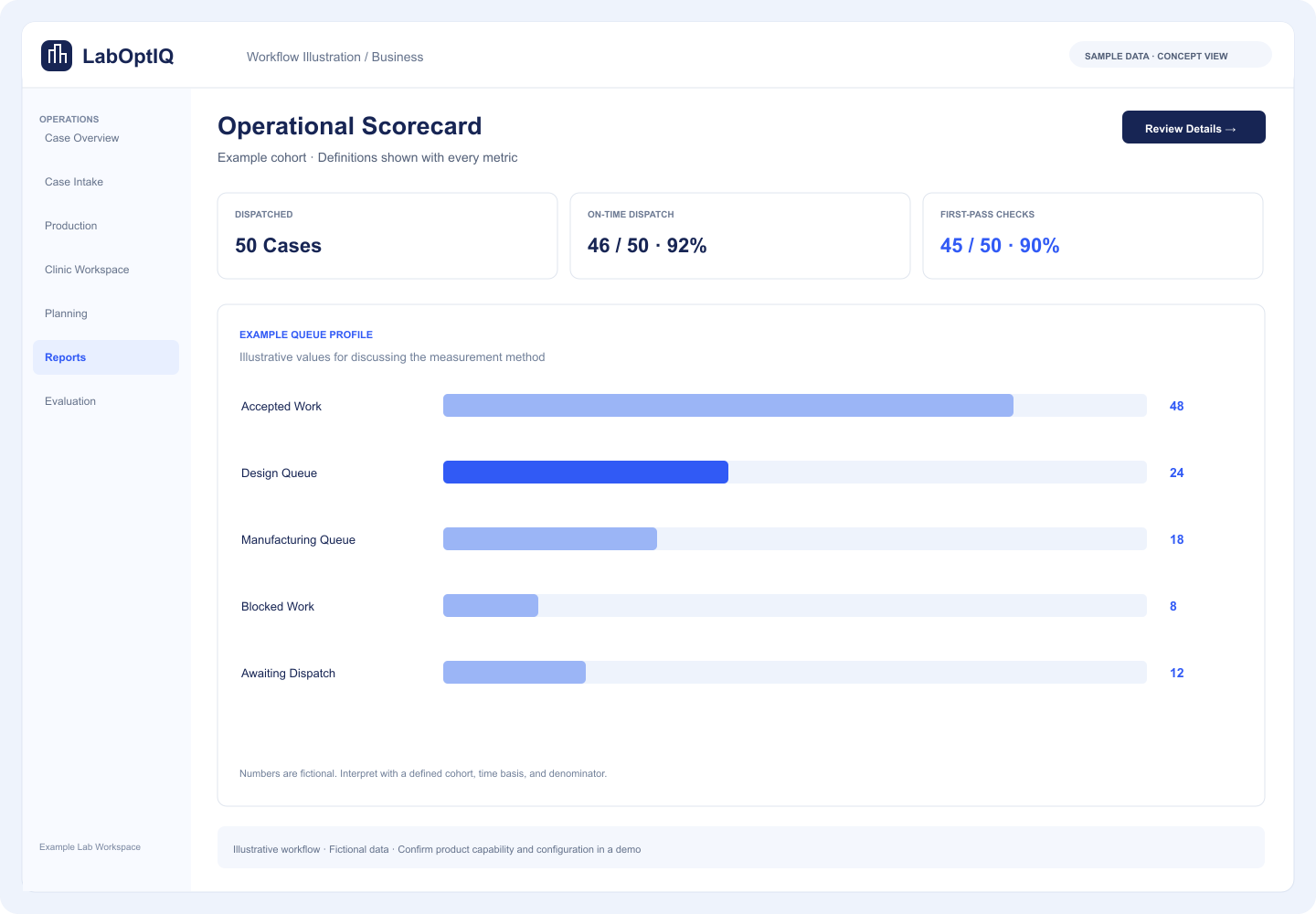
Explore this workflow with your team.
Bring your cases, scanner sources, and existing tools to a LabOptIQ demo. Confirm the handoffs, available features, and integration scope that matter to your lab.
Book A Workflow Demo