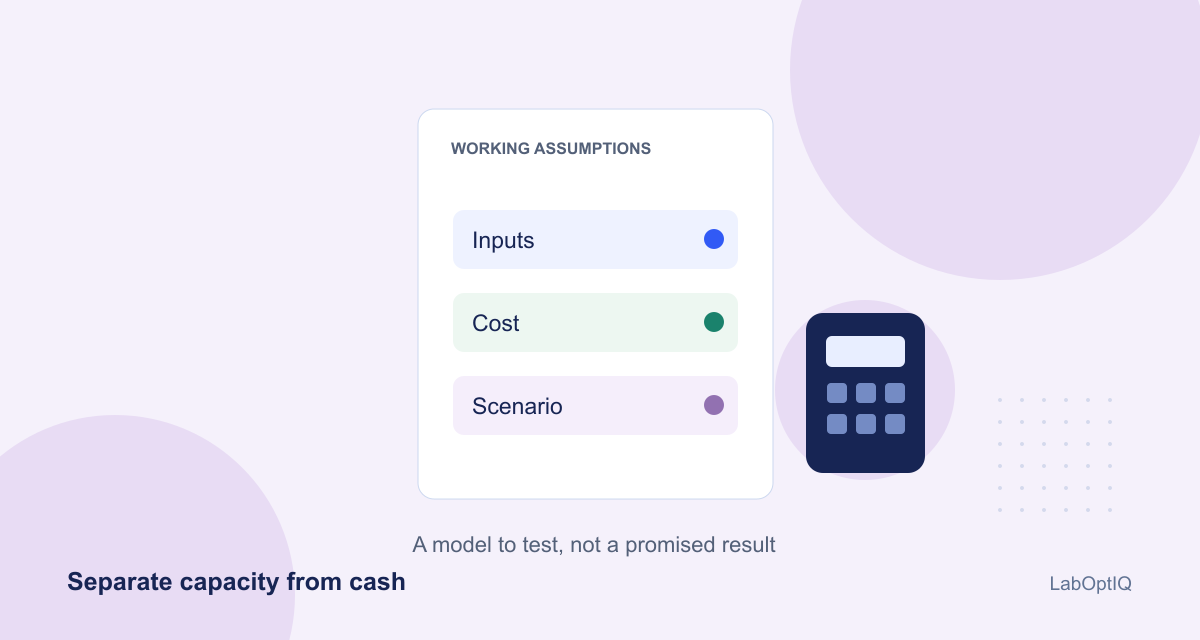
Establish a measured baseline
Observe the tasks the proposed system is intended to change: portal checking, repeated entry, status handling, reporting preparation, or another defined activity. Record the people involved, frequency, and time per activity over a representative period. Avoid adding together overlapping estimates of the same work.
Separate normal work from exceptions. A difficult migration week or a quiet holiday period may not represent ordinary demand. Record the case volume and case mix alongside time measurements so the model can be revisited when the workload changes.
Separate benefit types
A cash benefit requires a change in actual spending or receipts, supported by a reasonable explanation. Capacity value represents staff time that could be used differently. Additional contribution from more completed cases depends on demand, available capacity elsewhere, and the cost of doing that extra work.
Do not count the same hours as avoided payroll, additional production, and better service simultaneously. Choose the primary treatment and show other outcomes separately. If a benefit depends on adoption or a difficult integration, identify that dependency instead of assuming the full amount begins immediately.
Include the complete cost
List recurring subscription, connector, support, and usage charges, plus one-time setup, migration, training, and internal effort. Use a defined period, such as twelve months. Separate cash payments from the opportunity cost of staff time so readers understand what the total represents.
The basic return calculation is net benefit divided by total cost: (benefits − costs) ÷ costs × 100. State which benefits and costs are included. A model based on capacity value should be labeled accordingly rather than presented as a verified cash return.
Work through an illustrative scenario
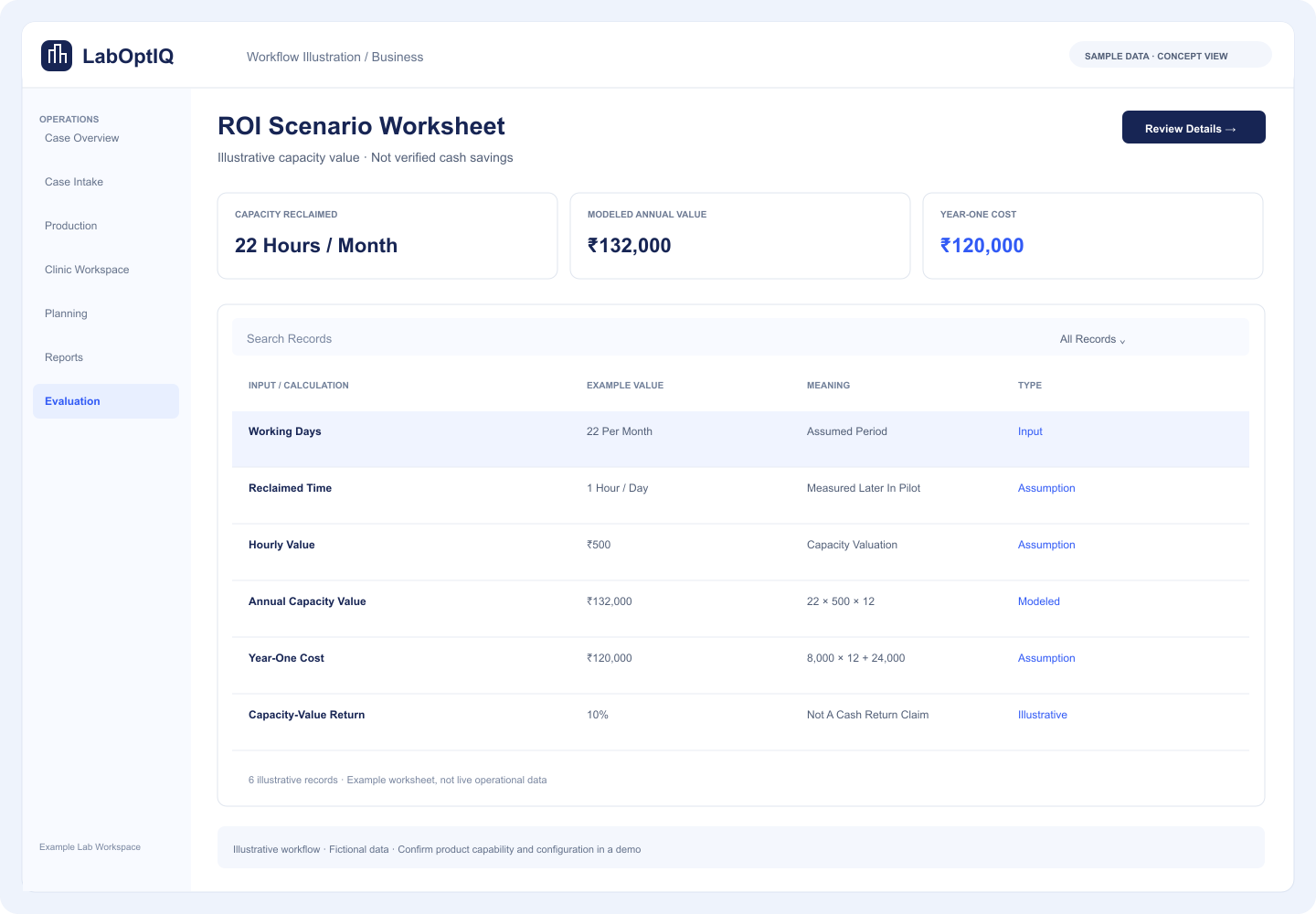
Suppose a hypothetical lab could reclaim one hour per working day across the affected tasks for 22 days each month. That is 22 hours. Valued at an assumed ₹500 per hour, the modeled capacity value is ₹11,000 monthly, or ₹132,000 annually. No actual cash saving is established by that multiplication.
With assumed recurring costs of ₹8,000 monthly and ₹24,000 one-time setup, first-year modeled cost is ₹120,000. The capacity-value return is (₹132,000 − ₹120,000) ÷ ₹120,000 = 10%. These are fictional planning inputs, not LabOptIQ pricing or customer results.
Test sensitivity and payback
If only half the assumed time is reclaimed, annual capacity value becomes ₹66,000 under the same hourly value, below the modeled first-year cost. That changes the conclusion materially. Test adoption, time reduction, workload, benefit realization, and uncertain charges rather than relying on one favorable scenario.
A simple payback calculation divides one-time cost by positive monthly benefit after recurring cost. In the full-capacity-value example, ₹24,000 ÷ (₹11,000 − ₹8,000) is eight months after steady benefits begin. If that monthly difference is zero or negative, simple payback is not reached under those assumptions. A ramp-up period changes the timeline.
Replace assumptions with pilot evidence
Agree the measures before the pilot and compare the same tasks afterward. Record any new administration introduced by the software. Ask your finance adviser to review the model before it supports a material purchasing decision.
Keep customer experience, traceability, and operational resilience visible even when they are not monetized. A decision can be justified by several outcomes, but the financial model should only claim what its inputs support. Bring this framework to a LabOptIQ demo and replace illustrative inputs with your own measured work and a scoped quote.
View A Workflow Example
Explore this workflow with your team.
Bring your cases, scanner sources, and existing tools to a LabOptIQ demo. Confirm the handoffs, available features, and integration scope that matter to your lab.
Book A Workflow Demo