Define the clock before setting a target
Decide whether turnaround begins at receipt, acceptance, or production release, and whether it ends at dispatch or confirmed delivery. Keep those events available separately. Two reports can describe the same workload very differently if one includes clinic clarification time and the other starts after every detail is resolved.
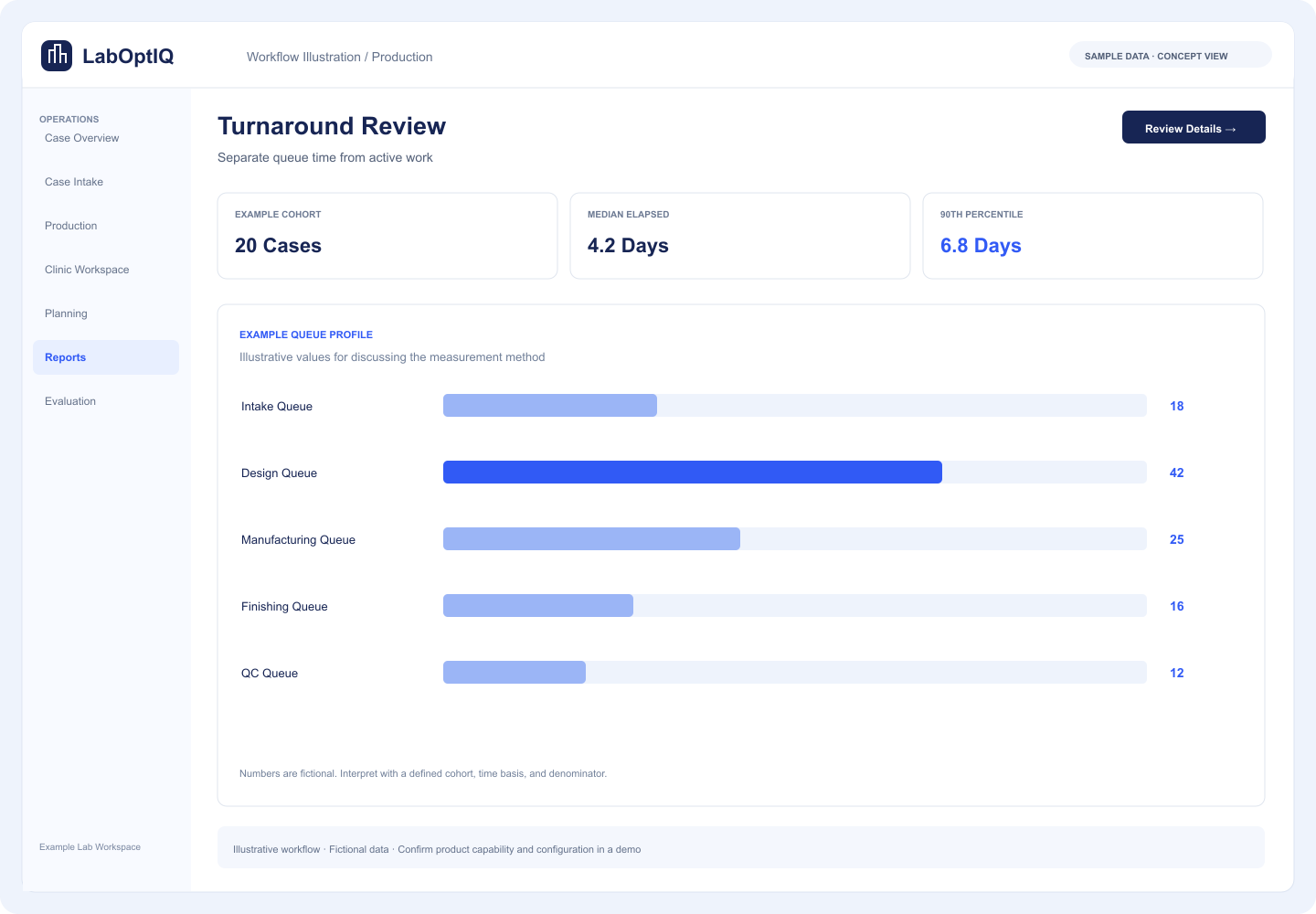
Group similar work together. Case type, complexity, outsourced steps, and agreed service level affect a realistic comparison. Report a typical value and a slower-tail measure, such as the 90th percentile, with the number of completed cases. An average alone can hide a small group of consistently late cases.
Separate work time from waiting time
Record when a case enters a queue and when active work starts. A design stage lasting two days may contain a short task and a long wait. Asking designers to work faster will not resolve a queue created by missing instructions, uneven release, or a downstream constraint.
Use a short sample if detailed timestamps are not yet available. Observe where cases collect and ask the owner what must happen before each can move. Keep the observation period and definitions consistent so later comparisons show a change in process rather than a change in measurement.
Improve intake completeness
Before acceptance, check the information and files required by the lab's procedures. Identify recurring gaps by clinic and case type without treating every clarification as someone's fault. A clear submission form and an agreed response owner can reduce repeated exchanges.
Do not accept an impossible date merely to clear the intake queue. Make the requested date, promised date, and any unresolved dependency visible. When a change affects the promise, communicate it deliberately and keep the earlier agreement in the history.
Plan around the constrained stage
Look for work waiting ahead of design, manufacturing, finishing, or QC. A busy department is not necessarily the constraint; the useful signal is a persistent queue that controls the flow of accepted work. Review skills, equipment availability, and rework before increasing release into that queue.
Batching may be necessary for a machine or material process. Make the batch cutoff visible and include its waiting time in the plan. Reducing one department's local processing time can still increase total turnaround if cases miss a downstream batch or arrive before that team can handle them.
Protect quality gates and control rework
Keep required reviews, manufacturer instructions, and professional judgment intact. Make failed checks actionable: record the issue, responsible person, disposition, and recheck requirement. A case marked complete before an unresolved issue is handled has not become faster; its uncertainty has moved downstream.
Analyze remakes and internal rework separately. They consume capacity that would otherwise serve new cases, but their causes can span intake, design, manufacturing, communication, and external factors. Link the evidence and discuss patterns with the people qualified to interpret them.
Test a bounded improvement
Choose one route and one change, such as earlier clarification or a clearer design-to-manufacturing handoff. Compare a representative baseline with the pilot using the same case grouping and date definitions. Track quality outcomes, missing updates, and late cases alongside speed.
A credible result explains what changed and for which cases. It does not promise that every future case will follow the fastest example. Use the findings to update realistic commitments, rather than turning a temporary reduction in workload into a permanent customer promise.
View A Workflow Example
Explore this workflow with your team.
Bring your cases, scanner sources, and existing tools to a LabOptIQ demo. Confirm the handoffs, available features, and integration scope that matter to your lab.
Book A Workflow Demo