Define the pricing unit
Ask whether the quote is based on users, locations, cases, modules, storage, or a combination. Clarify whether clinic accounts, technicians, temporary users, and administrators count toward the same allowance. An inexpensive base tier may not cover the people who need to maintain the record.
Write down the expected workload and growth assumptions. Compare proposals against that same scenario. A per-case and per-user model cannot be assessed fairly if one assumes your current volume and the other assumes a much larger team.
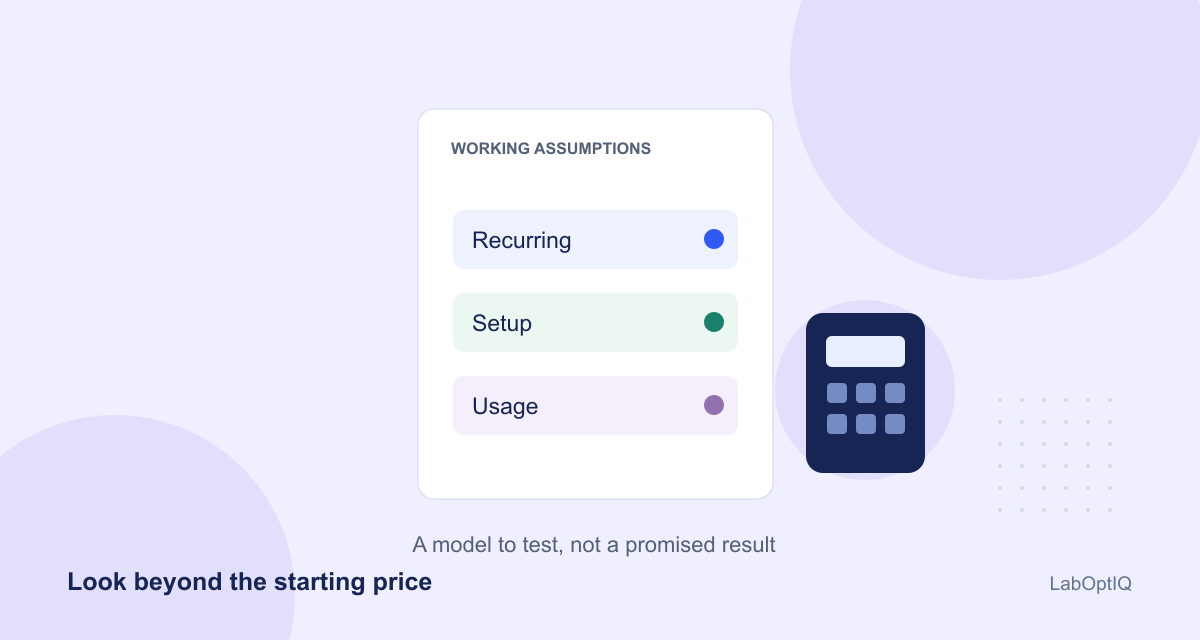
Separate recurring and one-time charges
Recurring costs may include the application subscription, support level, connectors, storage, messaging, or infrastructure responsibilities. One-time costs may include setup, data migration, configuration, integration work, and training. Ask which charges are mandatory for your required workflow.
Treat a quote with an unresolved integration as incomplete rather than automatically inexpensive. Confirm what is included in the connector: initial setup, maintenance, vendor changes, error support, and ongoing usage. The ability to exchange a sample file does not establish the scope of a supported production integration.
Include internal implementation effort
Your lab may need to clean clinic records, map product catalogs, review open cases, train staff, and operate a pilot. Estimate this effort separately from fees paid to the vendor. Keep time cost distinct from a cash payment so the model does not imply money changes hands when staff capacity is simply reassigned.
Plan for temporary parallel work and support after launch. An apparently free migration can still require substantial validation by your team. Agree what the vendor will deliver and what your staff must check before the data is considered usable.
Build a transparent example
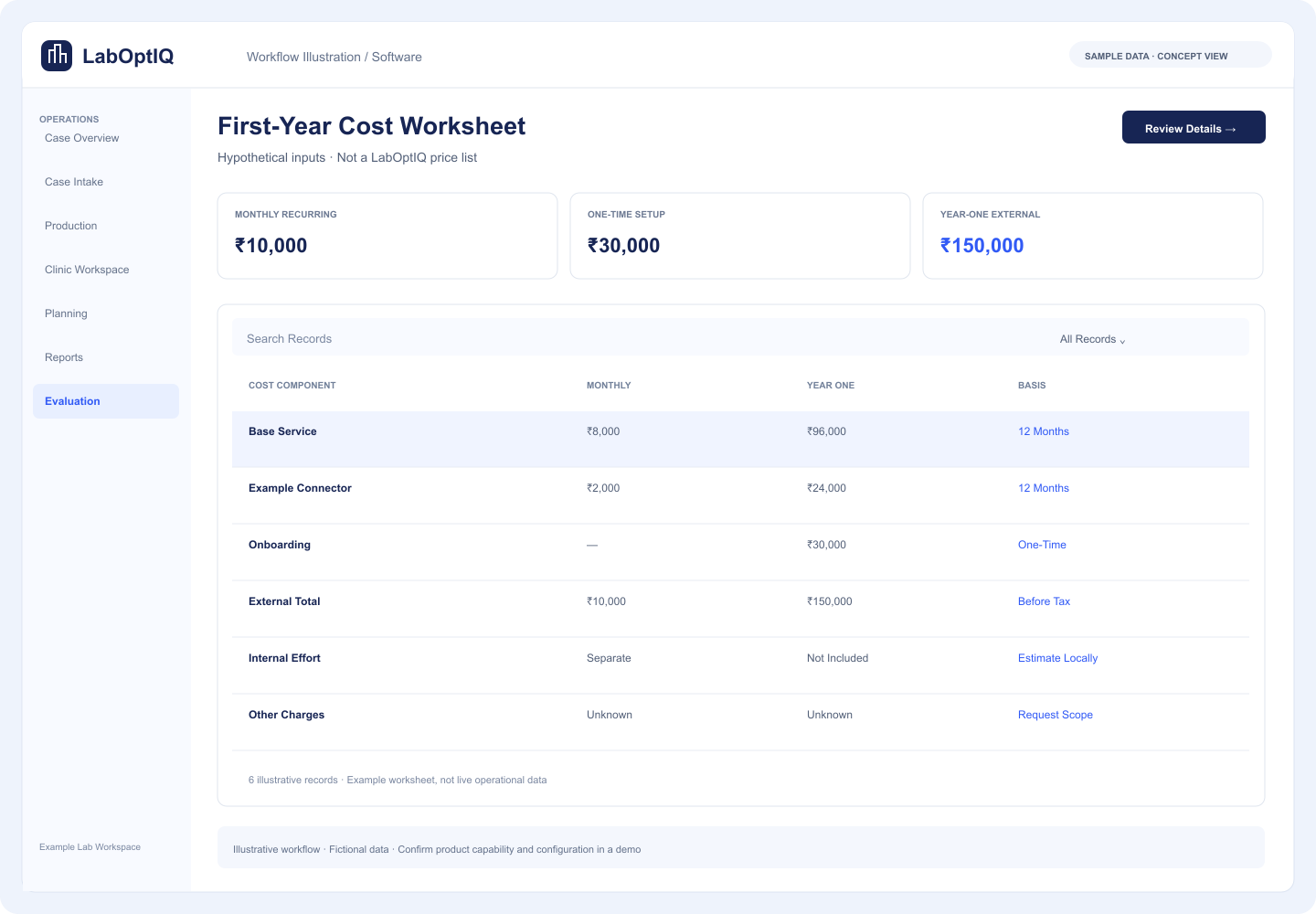
Consider a purely hypothetical quote of ₹8,000 per month for a base service, ₹2,000 per month for a connector, and ₹30,000 once for onboarding. The modeled first-year external cost is 12 × ₹10,000 + ₹30,000 = ₹150,000, before tax and any excluded services. This is not a vendor offer or a market benchmark.
The recurring year-two amount under unchanged assumptions would be ₹120,000, before tax and other changes. Add internal implementation effort on a separate line. If storage, volume, or support charges are unresolved, show them as unknown rather than entering zero.
Ask about growth, changes, and exit
Request written details about overages, additional sites, extra users, renewal changes, and custom work. Confirm whether quoted discounts expire and what happens if your case volume falls. Ask how changing a configuration or integrating another scanner is priced.
Review exports and termination assistance. Clarify whether files, case history, and configuration can be retrieved in a usable form and whether assistance is charged. Ask an appropriate adviser to review terms that create material contractual or financial commitments.
Compare cost with verified operational fit
Use price as one part of a requirements-led decision. A lower quote may still be a sensible option if it handles the essential work and leaves acceptable manual steps. A higher quote needs a practical explanation of the additional value, not merely more feature names.
Bring a workload scenario and request a scoped quote after the demo. For LabOptIQ, confirm current packaging, integration scope, onboarding, and ongoing support directly. Keep every illustrative amount in your own model labeled until it is replaced with a current written quote.
View A Workflow Example
Explore this workflow with your team.
Bring your cases, scanner sources, and existing tools to a LabOptIQ demo. Confirm the handoffs, available features, and integration scope that matter to your lab.
Book A Workflow Demo