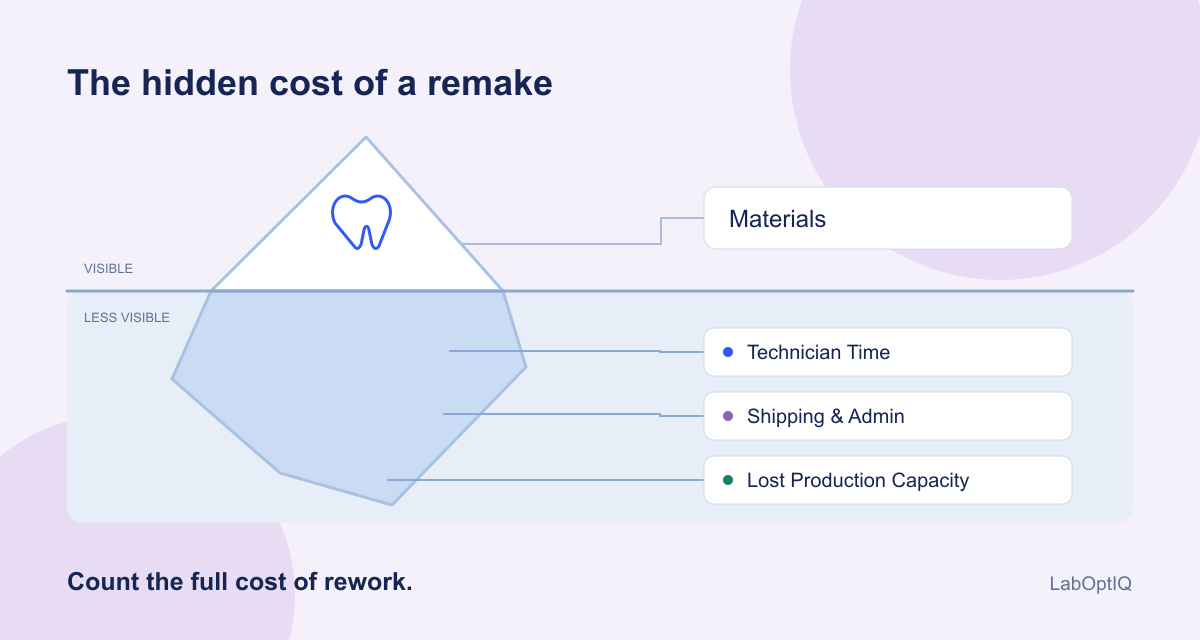
While occasional remakes are part of dental laboratory operations, repeated remakes can create significant financial and operational challenges.
The true cost of a remake goes far beyond replacing the materials used to manufacture the original restoration.
Understanding these hidden costs can help laboratory owners improve profitability, operational efficiency, and customer satisfaction.
Why Do Dental Lab Remakes Happen?
Remakes can occur for several reasons, and responsibility may lie at different stages of the clinical or laboratory workflow.
Common causes include:
1. Impression and Scan Quality
Inaccurate impressions, incomplete digital scans, or unclear margins can affect the final restoration.
2. Communication Problems
Incomplete prescriptions or unclear instructions about material, shade, occlusion, and restoration design can result in misunderstandings.
3. Manufacturing Errors
Problems during CAD design, milling, printing, sintering, finishing, or other fabrication processes may affect restoration quality.
4. Shade and Aesthetic Mismatches
Differences between the intended appearance and the manufactured restoration may require additional work.
5. Clinical Changes
Changes in treatment plans or clinical conditions can require modifications or replacement of a restoration, even when the laboratory followed the original instructions correctly.
What Does Research Tell Us?
A multicenter study published in The Saudi Dental Journal examined 40,344 fixed prosthodontic restorations produced across seven dental laboratories in Riyadh.
Researchers identified 2,612 remakes, representing approximately 6.5% of the restorations studied.
The study reported remake rates of 7.5% for veneers, 7.1% for onlays, and 6.9% for crowns.
Margin-fit discrepancies, proximal-fit problems, and general fit issues were among the leading documented reasons for remakes.
These findings illustrate why laboratories benefit from systematically measuring remake causes rather than treating every remake as an isolated event.
The figures reflect the particular study population and should not be assumed to represent every dental laboratory.
The Hidden Financial Impact of Remakes
Consider a hypothetical dental lab charging $150 for a crown.
The direct production costs might include materials, technician labor, equipment use, and finishing.
If the crown needs to be remade, many of those costs occur again.
But the financial impact doesn't stop there.
A remake may also involve:
- Additional technician hours
- Repeat material consumption
- Shipping and handling expenses
- Administrative coordination
- Production schedule disruption
- Reduced capacity for new cases
- Potential customer dissatisfaction
Some of these costs are easy to measure. Others are less visible but can still affect profitability.
For example, a technician spending additional time on a remake may have less time available for a new, revenue-generating case.
How Dental Labs Can Reduce Remakes
1. Standardize Case Submissions
Use consistent prescriptions with clearly defined requirements.
Make sure restoration type, material, tooth information, shade, and relevant clinical instructions are adequately documented before production begins.
2. Improve Quality Control
Introduce quality checkpoints at relevant stages of fabrication.
Inspect design parameters, margins, contacts, occlusion, finishing quality, and other restoration-specific requirements before dispatch.
3. Track Remake Reasons
Instead of simply recording a case as "Remade," capture a structured reason.
Categories might include impression issues, design errors, manufacturing defects, shade mismatches, fit problems, and clinical changes.
Separate the reason for the remake from the responsibility for the remake.
This distinction is important because not every remake results from a laboratory error.
4. Analyze Remake Trends
Review remake patterns by restoration type, material, production stage, and customer.
For example, if one restoration type consistently has a higher remake rate, managers can investigate whether the cause relates to design standards, material selection, production methods, or training needs.
5. Improve Dentist–Lab Collaboration
Encourage early clarification of incomplete prescriptions and provide a clear process for communicating design concerns.
Where appropriate, obtain approval before proceeding with complex cases.
6. Use Digital Tools for Better Visibility
A structured case management system can help laboratories document remake reasons, connect remakes to original cases, track additional costs, and analyze patterns.
However, technology alone does not eliminate remakes. Its value depends on the quality of the underlying procedures and the consistency of adoption.
Measuring the True Cost of Remakes
Laboratory owners should monitor more than the total number of remakes.
Useful indicators include:
- Remake rate: Percentage of eligible completed restorations requiring remakes
- Cost per remake: Additional materials, labor, shipping, and other direct costs
- Remake reasons: Distribution of documented root causes
- Turnaround impact: Additional production time caused by rework
- Repeat issues: Frequency of similar defects or problems
These measurements can provide a clearer picture of where improvement efforts will have the greatest impact.
Conclusion
Remakes are not always preventable, but their frequency and consequences can often be reduced through better communication, quality controls, technician training, and operational monitoring.
Dental laboratories that consistently analyze remakes can gain valuable insights into their production workflows.
Rather than treating remakes purely as individual failures, laboratories can use them as opportunities to strengthen processes, control costs, and deliver more reliable restorations.
Final takeaway: Reducing remakes is not only a quality improvement initiative. It is also an important part of protecting laboratory profitability and building long-term trust with dental practices.
Explore this workflow with your team.
Bring your cases, scanner sources, and existing tools to a LabOptIQ demo. Confirm the handoffs, available features, and integration scope that matter to your lab.
Book A Workflow Demo