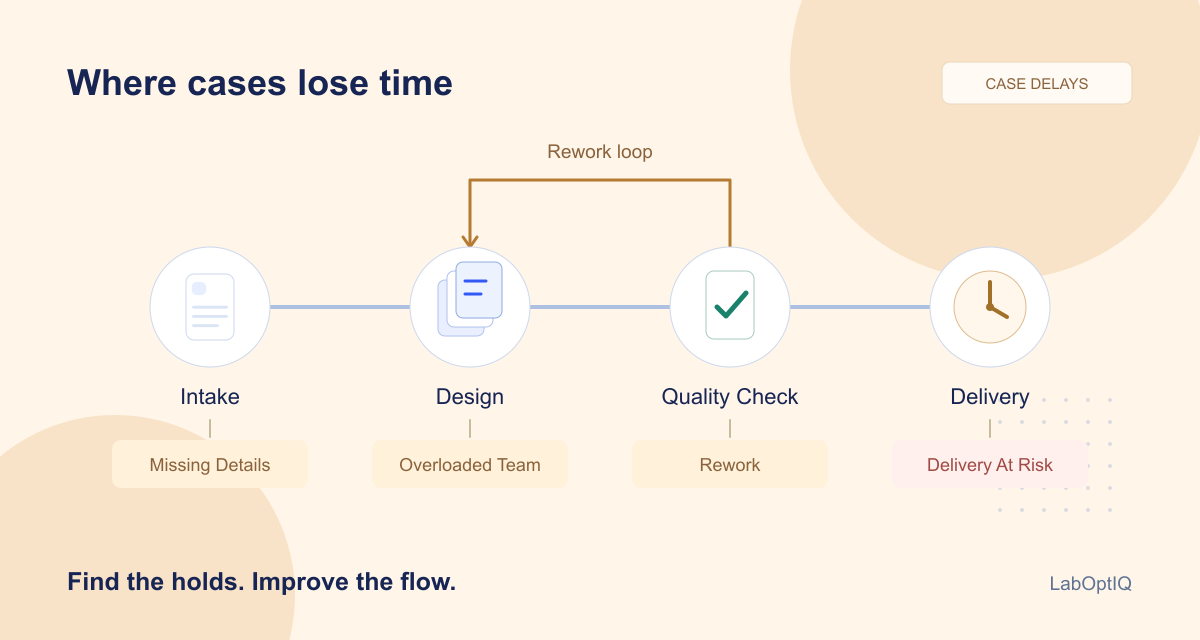
Even experienced dental laboratories can struggle with production delays, particularly as case volumes increase.
A delayed case doesn't simply affect the lab's schedule. It can disrupt a dentist's appointment calendar, inconvenience patients, increase production costs, and weaken the relationship between the dental practice and the laboratory.
Understanding why these delays occur is the first step toward preventing them.
1. Incomplete Case Information
One of the most common reasons a dental case gets delayed is missing or unclear information.
A dental practice may submit a case without specifying the restoration material, shade, required delivery date, or other essential details.
The technician must then contact the dentist and wait for clarification before proceeding.
This back-and-forth communication can delay an otherwise straightforward case.
How to improve:
Introduce a standardized case submission process that captures all required information before the case enters production. Digital prescriptions, mandatory fields, and clear communication channels can reduce avoidable clarification delays.
2. Limited Visibility into Case Progress
In laboratories that rely heavily on paper forms, spreadsheets, or verbal updates, understanding the current status of a case can be difficult.
A lab manager may need to walk across different departments to determine whether a case is being designed, milled, finished, or prepared for delivery.
Without a centralized view of production, identifying bottlenecks becomes harder.
How to improve:
Establish clearly defined production stages and track every case as it moves through them.
A shared production dashboard or structured tracking system can help managers identify delayed cases before they miss their deadlines.
3. Uneven Technician Workloads
Not every technician has the same skills, and not every restoration requires the same amount of work.
Some technicians may be overloaded with complex cases while others have available capacity.
Without effective workload planning, laboratories can experience unnecessary production bottlenecks.
How to improve:
Assign cases based on technician specialization, estimated production time, current workload, and delivery priority.
Regular workload reviews can help distribute assignments more effectively.
4. Poor Communication Between Dentists and Laboratories
Dental laboratories depend on timely communication with their customers.
Questions about shade selection, impression quality, design preferences, or restoration specifications may require immediate clarification.
When these conversations happen across phone calls, text messages, and email threads, important information can be overlooked.
How to improve:
Maintain a centralized communication history for each case.
Every clarification, design approval, or specification change should be recorded and accessible to authorized team members.
5. Unexpected Remakes and Rework
A restoration that fails quality checks or requires remaking can disrupt the laboratory's production schedule.
Remakes consume technician time, materials, and equipment capacity that would otherwise be allocated to new cases.
How to improve:
Implement quality checks at critical production stages and maintain records explaining why remakes occur.
Reviewing recurring issues can help laboratories improve processes and prevent similar problems.
6. Lack of Production Performance Data
Many laboratories know how many cases they complete each month but have limited visibility into where time is actually spent.
Without reliable data, managers may struggle to answer important questions:
- Which production stages experience the most delays?
- Which restoration types consistently take longer?
- How many cases are delivered on time?
- Which steps generate the most rework?
How to improve:
Start measuring a few practical indicators, including average turnaround time, on-time delivery percentage, production-stage duration, and remake rate.
These metrics can help laboratories make better operational decisions.
Building a More Predictable Laboratory Workflow
Improving dental lab turnaround time does not always require expensive equipment or a larger team.
Often, improvements begin with clearer case instructions, better communication, consistent production tracking, and smarter workload management.
Technology can support these processes by improving visibility and reducing manual coordination. However, effective workflows and trained technicians remain essential.
The goal is not simply to produce restorations faster. It is to create a reliable, predictable production process that delivers consistent quality and meets customer expectations.
Final takeaway: Dental laboratories that understand where delays occur are better positioned to improve turnaround times, reduce operational stress, and build stronger relationships with dental practices.
Explore this workflow with your team.
Bring your cases, scanner sources, and existing tools to a LabOptIQ demo. Confirm the handoffs, available features, and integration scope that matter to your lab.
Book A Workflow Demo